
Issue No. 5
1966 Eastern Conference Semifinal | Game 4

From the Rafters is an infrequent newsletter featuring a series of essays that revisit classic NBA basketball games. If you dig it, please help spread the word by sharing it with the other basketball fans in your life. If you’ve been sent this newsletter from a friend you can subscribe below. Thanks for reading.
Since my last dispatch from the rafters, basketball fans have seen three new champions crowned in the NBA. LeBron James brought one1 home to the Lakers during his second season in Los Angeles. Eight months later, Giannis Antetokounmpo assumed his rightful place atop the mountain with a Finals-clinching fifty-piece for the Milwaukee Bucks, and last month Stephen Curry solidified his already remarkable legacy with a fourth Golden State Warriors championship and two playoff MVP trophies.
So here we are again, in the summer doldrums of another NBA offseason. Collegiate hoopers were drafted last month, and the free agency frenzy is upon us. That’s all good enough for the layman’s hot stove, but a few days after that thrilling Golden State victory—in an attempt to feed the void that I have otherwise filled watching Robert Altman’s films one after another—I found myself studying my favorite Wikipedia entry, “List of NBA champions: Results by Team,” and looking for more old games to watch.
At the top of the list, the Lakers’ recent win has vaulted them above the Boston Celtics. Questionably though, Wikipedia’s tie-breaker for 17 league championships is calculated in total appearances and not winning percentage. I haven’t written about those teams here yet, but with Winning Time in the zeitgeist maybe I’ll dip my toe into those halcyon waters soon.
Clinching the third spot on the “List of NBA Champions,” Golden State’s seven franchise wins (including one BAA victory, and two more during their years in Philadelphia) puts them beyond Michael Jordan’s Chicago Bulls (See: From the Rafters, Issue No. #4). Which means that now the top three winningest NBA franchises all have roots in the original National Basketball League or Basketball Association of America. It’s hard to imagine the Bulls taking one back anytime soon, and it might be a hundred seasons before any team, even the Warriors, can catch up to 17.
I can’t emphasize how much I love this list, which chronicles both victories and losing appearances. At a glance you can see the entire history of the NBA sketched out before you—dynasties well-known and victories obscure. Gregg Popovich’s remarkable 15-year stretch running the sound, fundamental, and unsexy Spurs in the fifth slot. Below them, Dr. J’s four post-ABA merger Finals appearances with the Sixers (and Iverson’s single). Further down, the Bad Boys of Detroit, Riley’s Heat and Knicks—neck and neck as it should be. As well as the defunct anomalies—the St. Louis Hawks, Seattle Supersonics, and the 1951 NBA Champion Rochester Royals.
Which leads me to today’s game.
Before traveling west to become the Sacramento Kings, the Royals stopped off in my home state of Ohio and spent 15 seasons playing in the Cincinnati Gardens, from ‘57 to ‘72. For ten of those seasons, the Cincinnati Royals were led by their local college hoops hero, the 1964 league MVP, and future Hall of Famer, Oscar Robertson. The original Mr. Triple-Double.
The Big O never managed to take the Royals to an NBA Finals, but he spent six of his seasons in Ohio competing in the playoffs. In 1966, Robertson’s Royals met the Boston Celtics in the first round for a best-of-five series, and jumped out to a 2-1 lead. So here, Hardwood Classics presents to us, Game 4 of the 1966 Eastern Conference Semifinals.
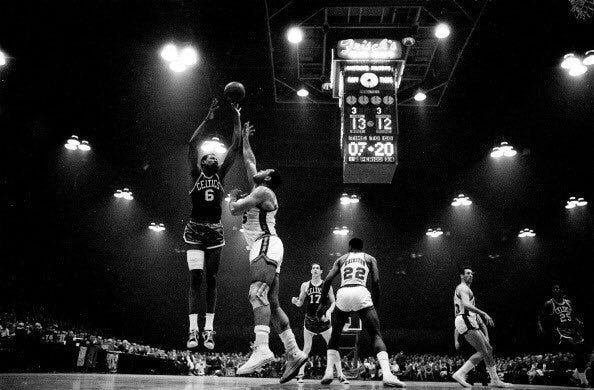
First, let me address the elephant in the room. This game is a blowout and the surviving footage isn’t very competitive. I hope you’ll keep reading of course, but I needed you to know that upfront because the NBA is to blame.
Remarkably, even after 9 months of celebrating their diamond jubilee ad nauseam, the league continues to negligently handle their archive. Yes, sure, you can watch any playoff game from the past 21 years on League Pass. Thanks, but how about anything from the league’s first 54 seasons? Michael Jordan? Get out of here. Magic and Bird? Try again.
This game is just one of two Hardwood Classics that are currently2 available on the League Pass app (the next FTR issue might be riffing on a bootleg), it only captures the third and fourth quarters of the broadcast, and Boston comes out of the halftime break already staked to a 10 point lead. Plus, the chyron on the screen spoils the outcome immediately.
There is a documentary film version of the decisive Game 5 (if you watch Game 4, do yourself a favor and bootleg that one), but it’s disappointing that this game is the best the NBA can offer in its original form from a pretty exciting series. Each other victory was decided by single digits, and the only home court win was the last one in the Boston Garden. I’d be thrilled to learn that footage of the other games in this semifinal exist, but trying to find out more information about the elusive NBA archive feels quixotic. The league’s history deserves better respect.
Demolished in 2018, the Cincinnati Gardens officially held about 11,000 spectators, which in basketball terms puts it just slightly ahead of Duke’s Cameron Indoor Arena. But on March 30th, 1966, with 12,107 souls in attendance, Robertson’s Royals were just one win away from eliminating the seven-consecutive-time NBA champs.
The surviving broadcast is captured from Boston’s WHDH-TV, and local sportscaster Don Gillis is the sole man in the booth for the game. He quickly recognizes the ferocity of the Cincinnati faithful, calling it their “very best playoff crowd ever.”
“Right now in Cincinnati Garden, it’s sorta pandemonium,” Gillis later says, describing the raucous atmosphere. “They give away souvenirs here, they throw small balls, about the size of softballs, into the crowd. And uh, one just flew by my ear a minute ago.”
There’s something magical about the stripped-down broadcast. Without the bells and whistles that we’re accustomed to today, some amazing little details are allowed to seep through the screen. About nine minutes in, during a timeout, you can hear a pretty swinging jazz band. What I would give for a one-off “Jazz Night” in the NBA today, with a live band and no artificial music prompts. Whenever Utah next visits New Orleans would be a pretty good option™.
What you can see of the crowd is only visible court-side, the camera never pans too far from the action on this broadcast, but when it does you’ll notice that there is a number of small children in the front section, an uncommon sight in today’s arena. Not surprisingly it is also a mostly male, almost entirely white audience. This despite the fact that the 1960s saw a surge in Cincinnati’s Black population, and two once-in-a-generation, Black basketball talents headlined this series. It’s as disappointing to see this lack of diversity in the audience in 1966 as it is in 2022.
You’ll see them match up almost immediately. On the second play of the half, Robertson receives a post-rebound handoff from teammate Happy Hairston, and brings the ball up the court to the Cincinnati crowd’s delight. Robertson takes Boston’s Sam Jones to his left, easily turning the corner into the paint, only to be firmly rejected by the helping Bill Russell, who stares Robertson down after the block. It’s not the opening play of the game, but it’s a pretty good summary of the entire thing.
Blocks were not recorded as a stat in the NBA until 1973, but Russell quickly notches another on Robertson about 15 seconds later. At this point, it’s not very difficult for this viewer to see how the legendary Celtic center won the league title 11 times in just 13 seasons. Even with his right hamstring taped up, Russell makes rebounding look as easy as his blocks, barely even jumping for some.
The game itself is much slower than today’s, of course, but it still has hallmarks of a good modern offense. The Celtics want to play in transition, especially around Russell’s superb defense. Halfway through the third period, Russell pulls down one of his 26 rebounds and whips the ball with his left hand to a running John Havlicek at half-court. Havlicek takes one dribble then hits Sam Jones on the outlet pass, threading the ball between two Royals defenders, for an easy layup.
Boston’s coach Red Auerbach, who would retire after the ‘66 season and move into the team’s front office, took his fastbreak inspired style of play from his college coach at George Washington University, Bill Reinhart. If you watch the documentary about Game 5, the film’s narrator breaks down a few fundamental basketball plays, using replays from multiple angles, and does a good job highlighting Boston’s fastbreak play, help defense, and half-court schemes.
Despite trailing by 10 or more points for most of the 3rd and 4th quarters, the Royals are able to keep pace with their hot shooting. Forward Jerry Lucas, later part of the Knicks ‘73 championship team, has a pretty impressive hook-shot and midrange jumper. If there had been a three-point line in ‘66, the Royal’s Jon McGlockin would certainly have had the range, but here a handful of deep twos lead to just 11 points.
Eventually, Oscar Robertson looks every part of the versatile MVP he was, even in a game that never feels within reach for the Royals. His high arcing shot allows him to avoid Russell’s outstretched arms, often hitting nothing but net. His free throw motion, however, is extremely unorthodox as he takes his left hand off the ball just before the shot, but it works. By the end of the third quarter Robertson has 27, but his team is down 15 points, and the Celtics are just too organized on both sides of the ball to give anything back.
In between quarters, during a lack of commercial broadcast breaks, the crowd noise pulls you into the arena for a few moments. The steady murmuring of cheers and the hail of whistling, even though the hometown team has been all but counted out, bring the atmosphere to life.
Gillis calls an exciting game too, especially when the action gets hot. He colorfully describes one particular Celtic fastbreak with, “Siegfried on the sneak away!” And since Boston doesn’t have names on their jerseys, he gives a radio-esque level of detail to each player’s action, probably because it was being simulcast.
Boston just doesn’t miss in the 4th quarter. In a brief span every possession feels meaningful, as Siegfried, Havlicek, Sanders and Jones drain jumper after jumper. All four finish in double-figures. A portion of the crowd heads for the gates with about 3 minutes to go, and shortly after Robertson checks out for the final time. The Royals throw in the towel.
In this game, Bill Russell’s impact is felt solely on defense and with his rebounding. In the waning minutes, he picks up half of his 8 points, but the camera misses an emphatic dunk after cutting to the scoreboard and lingering a second too long. It’d be nice to have more of his legendary career available to screen and see how his play transformed the league around him. I assume that a player like Robertson thrives in the NBA in the mid-60s because his athleticism, vision, touch, and speed are exactly what is needed to break down a stopper with the stature of Russell.
The NBA in 1966 is obviously something entirely different than what it is today. But this feels like the kind of match-up—styles make fights, they say—that the sport needed to evolve into its modern form. Game 4 isn’t necessarily the best example of it, but the surviving footage from the documentary of Game 5 shows the kind of excitement this Eastern Conference Semifinal had to offer, and I’m glad to have spent a little time with some of the game’s greats.
Instant Replay
Final Score: Boston 120 - Cincinnati 103
The New York Times’ Recap, which also provides this all-timer of a line from Auerbach:
“I sure didn’t want to end my coaching career in Cincinnati.”
Stream the game in the League Pass App (while you can)
Out of Bounds
“We want to remind you folks that the Barbara Streisand Show for WHDH in Boston has been videotaped and will be shown in its entirety at the conclusion of the game.”
Broadcaster Don Gillis was also famous for hosting a Candlepin Bowling show. If I can’t find a good stream for the next newsletter, I may write about this instead.
“5th and deciding game in Boston on Friday night. Tickets go on sale at 10am tomorrow.” I kind of wish we’d go back to selling tickets this way, don’t you?
Flagrant Fouls
It’s a jump ball to start the 4th!
Gillis alternates the terms periods and quarters.
The legendary Chicago Zephyr3 Don Nelson comes off the Celtics bench. His free throw form is also unique, leaning into the shot and almost kicking his left leg behind him at release.
Bubble
If you’re lucky and it’s still there tomorrow or whenever you’re ready this.
Or rather, the second all-time winningest NBA coach.